
Winter is often the quietest time on the farm, but for nature it can be one of the most important seasons of the year. While wildlife slows down, it gives us the opportunity to focus on the long-term work that helps habitats thrive – restoring the connections between them.
Across much of the British countryside, wildlife habitats have become increasingly fragmented. Ancient woodlands, chalk grasslands, wetlands and farmland can often sit like isolated islands in the landscape. For many species this makes it difficult to move safely between areas to find food, shelter or new territories. Over time, this lack of connectivity can reduce genetic diversity and make populations more vulnerable.
One of the most effective ways to tackle this challenge is by creating wildlife corridors – simple but powerful features such as hedgerows, grass margins and riparian strips that link habitats together. These corridors allow animals, insects and plants to move across the landscape, turning isolated habitats back into connected ecological networks.
A Busy Winter for Hedgerow Planting
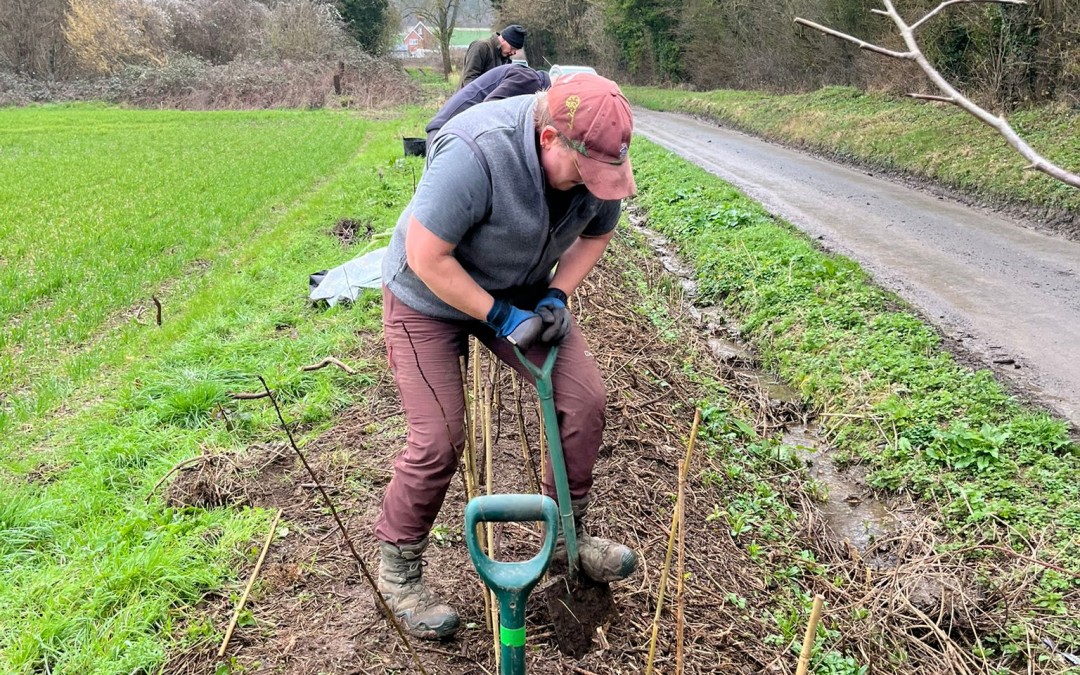
This winter has been a busy one at Birling Estate. With the help of our friends at Medway Valley Countryside Partnership, CPRE, and a fantastic team of local volunteers, we’ve planted more than 1 kilometre of new hedgerows across the estate.
Hedgerows are one of Britain’s most valuable wildlife habitats. A well-managed hedge can support hundreds of species, providing nesting sites for birds, food for insects, shelter for mammals and safe passage across farmland.
For one species in particular, these new hedges will play an especially important role – the Hazel Dormouse. These tiny woodland mammals rely heavily on well-connected hedgerows to move safely through the landscape. By linking woods and scrub habitats together, the new planting will help our local dormouse population explore new areas, find mates and maintain healthy genetic diversity.
We’re not stopping there. Plans are already in place to plant another kilometre of hedgerow this coming December, and we’ll be welcoming volunteers who would like to get involved with the planting effort.
Bringing Back the Elm
Another exciting development this winter has been the planting of a number of disease-resistant elm trees, supported through the Network Rail Community Tree Planting Fund.
Elm trees once dominated many parts of the British landscape before Dutch Elm Disease dramatically reduced their numbers. Their return is particularly important for one species: the White-letter Hairstreak butterfly. This beautiful but often overlooked butterfly relies almost entirely on elm trees as its larval foodplant.
By planting disease-resistant elms, we hope to create new habitat for the White-letter Hairstreak and support the recovery of this priority species in the Kent & Medway Local Nature Recovery Strategy.
Supporting Hazel Dormice Across the Landscape
We are also delighted to be taking part in Natural England’s Hazel Dormouse Project. As part of this initiative, the hedgerows across Birling Estate – along with those of our partners within the North Kent Woods and Downs National Nature Reserve – have recently been surveyed.
These surveys will help build a clearer picture of how dormice are using the landscape and where habitat improvements can make the biggest difference. From this work, plans will be developed to enhance and expand the network of hedges, woodland edges and scrub that dormice depend upon.
Small Features, Big Impact
Hedgerows, grass margins and tree lines may seem like small features in the landscape, but collectively they form the threads that stitch nature back together. When these connections are restored, wildlife can move more freely, populations become more resilient and the whole ecosystem becomes stronger.
It’s encouraging to see what can be achieved through partnership working – from conservation organisations to local volunteers – all helping to rebuild a more connected landscape for wildlife.
And with more planting planned for next winter, the work of reconnecting nature at Birling Estate is only just beginning.
Recent Comments